Agent-Lab applications share one domain model, defined in agent_lab/domain/. The
same model powers the REST API schemas, the persistence layer and the agent runtime —
learn it once and you know what every endpoint reads and writes.
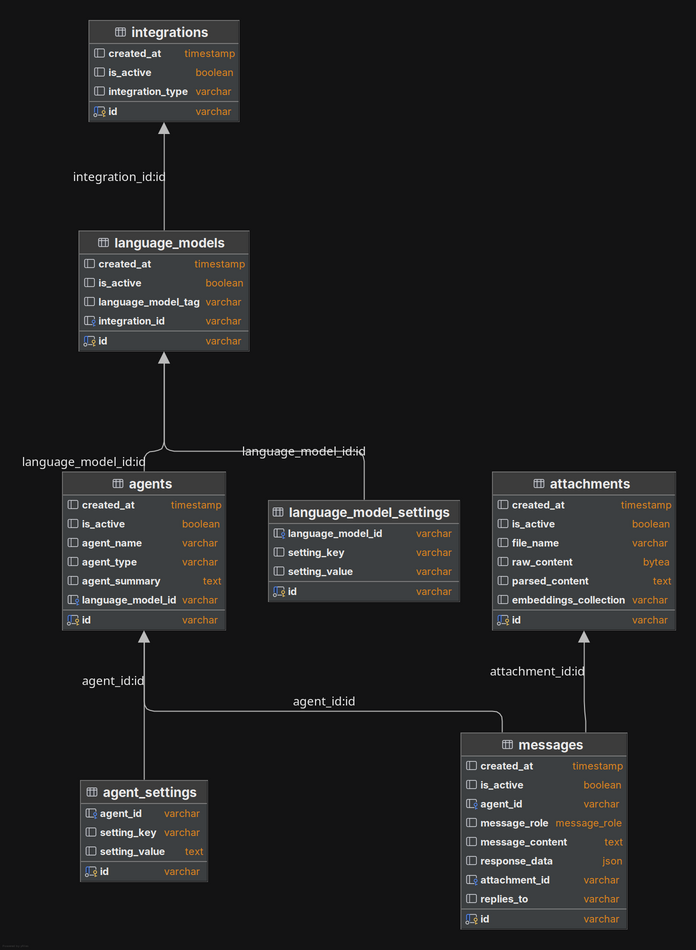
Entities
| Entity | What it models |
|---|---|
| Agent | An LLM agent instance — agent_name, agent_type (validated against the registry), active flag and timestamps. One implementation, many configured instances. |
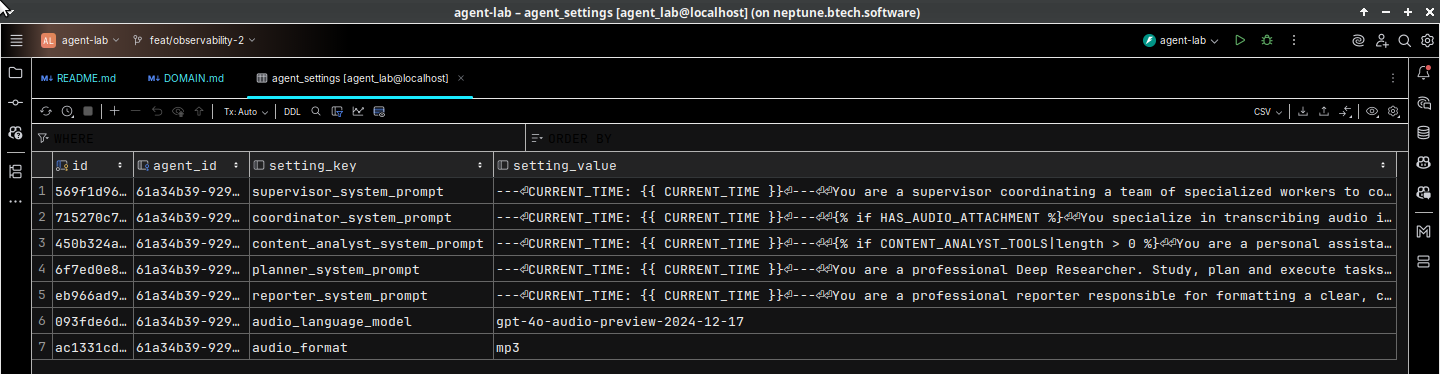
| AgentSettings | Key-value configuration of an agent instance: prompts (Jinja2 templates), collection names, temperature, custom values. Up to 16,000 characters per value — this is where agent behavior is tuned via POST /agents/update_setting. |
| LanguageModel | A language model available to agents, with its supplier connection. |
| LanguageModelSettings | Per-model parameters (temperature, max tokens, …), managed via the /llms endpoints. |
| Integration | An external integration (e.g. an AI supplier) and its configuration. Secrets are stored in Vault, never in the database. |
| Message | One conversation turn: role (human / assistant / tool), content, response_data, and thread links (replies_to). Persisted with the agent's memory via LangGraph checkpoints. |
| Attachment | A file attached to a message: raw content, parsed content, and the embeddings collection reference used for retrieval. |
An example of persisted agent settings — prompts and custom values for the voice memos agent — from notebooks/08_test_agent_type-multiagent-voice-assistant.ipynb:
Where data lives
Agent-Lab uses three PostgreSQL databases (plus Redis) — provisioned by the
deployment guide and configured via db.url, db.vectors and
db.checkpoints (see the Configuration reference):
| Store | Contents |
|---|---|
db.url |
Relational data: agents, settings, models, integrations, messages, attachments |
db.vectors |
pgvector embeddings — vector search and retrieval (/attachments/embeddings) |
db.checkpoints |
LangGraph checkpoint data — agent memory across interactions |
Redis (broker.url) |
Pub/sub broker for status updates on long-running operations; also MCP OAuth client storage |
Security and secrets management
Secrets — integration credentials, model API keys, the configuration payload itself — are managed with Vault. The database stores references; the sensitive values are retrieved from Vault at startup and on demand. See Secrets with Vault and the Configuration reference.